


Key Points
Considerations for facilitators and, well, really anyone in a position of privilege: reflect on the power you hold, who is in the room, and who isn’t in the room - and then seek out those underrepresented voices
The necessity of humility, ceding power, and letting go of rigid processes, in the face of the overwhelming need for transformative systems change
The default: conservation organizations enter a situation with a “solution” already in mind. What we need instead: be prepared to co-design, i.e., listen humbly and be willing to stand up for what the community needs
How to cope with wanting to effect major structural change… but being an individual up against organizational inertia
The Question: go back to academia? On her decision to pursue a Ph.D.
Another Question: what roles can privileged Global Northers serve, ethically, in international conservation? (Something we’ve both been grappling with)
The need to bring in more of “the human, intrinsic reasons that we do the things we do, the love and care that we have” into conservation
“Because I truly believe that solutions lie at the intersection of different perspectives and viewpoints, and that we have to have dialogue in order to craft those solutions.” - Alexis Rife
INTRODUCTION
Well, here it is - the final episode of 2025. This marks 42 episodes of Conservation Realist, though I wouldn’t bet too much on the accuracy of my episode accounting, and that’s the perfect number to pause on for now. I turned 42 this year, and many of you likely recognize the significance of 42 from the Hitchhiker’s Guide to the Galaxy (a favorite).
It’s fitting that this episode features a conversation with Alexis Rife, a colleague and friend who I’ve had several wonderful conversations with over the years. We met at Scripps Institution of Oceanography when she was doing her Master’s of Advanced Study at the Center for Marine Biodiversity and Conservation, and we primarily interacted through the formation of the Small-scale & Artisanal Fisheries Research Network there, my effort to help my fellow students who were similarly embarking on studying small-scale fisheries but had very little idea how to study people. I appreciated her insights and contributions during that process, and I’m glad we’ve kept in touch over the years.
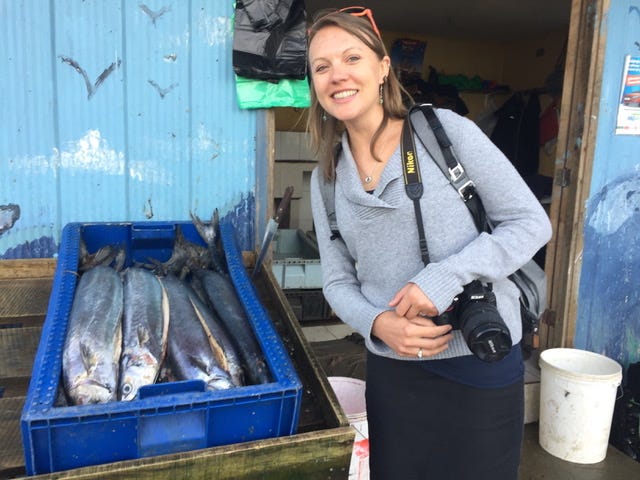
She’s had a fascinating career and has patiently let me interrogate her about it, and then agreed when I eventually asked to record some of my interrogations. She’s worked with Environmental Defense Fund (EDF), and I have a lot of respect for what I’ve observed of EDF’s work on fisheries as well as her colleagues at EDF who contributed very generously to guiding some of our research students in Myanmar. She then moved into the realm of facilitation at Meridian, which unfortunately closed down this summer; I’ve long felt that we need more facilitation skills integrated into conservation training, and I myself would love to learn to be a better facilitator, so I just loved that step in her career. And now, she’s an independent consultant who has been mulling over the idea of returning to academia for a PhD, and we discuss that in our chat.
It was helpful to revisit a topic we’d discussed before: finding our role in conservation, and reckoning with how to responsibly contribute to the field from our position as privileged Global Northers who have primarily worked in the Global South. From my previous post, you’ll recall that I’ve been thinking about this a lot this year. For those of you who are going through something similar, I hope it’s helpful to know that you’re definitely not alone in this.
With that, I want to with you all Happy Holidays and a wonderful start to the New Year. It might be asking a bit much, but I hope you all have the chance for some genuine rest, connection with loved ones, and joy as the year wraps up. I’ll be back in February, with some exciting changes - I look forward to connecting again then! Thank you for being with me. Enjoy the conversation below!
TRANSCRIPT
T: Great. There we go. So yeah, thank you again for being willing to chat with me in a recorded capacity.
A: My pleasure.
T: I’ve always enjoyed our conversations about conservation. I don’t know how you feel about this characterization, but I have kind of a category of colleague that I define as: someone who I’d be happy to sit in the back of a room at a conference, muttering under my breath, to, and feeling very confident that my point will be understood and not taken the wrong way.
A: I love it.
T: I hope you don’t mind that, but you’re in that category to me.
A: I’ll take it. I’ll take it. I love that kind of categorization of colleague!
T: And it’s nothing mean spirited, just like, “yeah, it doesn’t really make sense…”
A: Exactly.
T: And I was also thinking that the number of times we’ve actually seen each other in person since being at Scripps together is very small. And I remember that one time we crossed paths, like literally just crossed paths, at the airport in Yangon.
A: Oh my gosh – totally! I forgot about that. A small, a small world moment for sure.
T: But it’s great to be able to chat with you on Zoom. I’d love to start off with you giving a brief introduction to yourself. Briefly, what you’ve done, what you’re doing in conservation, whatever you feel like sharing.
A: Yeah, so Alexis Rife, she/her, and I have really spent my life working on oceans and natural resource management issues. Whenever I get this question, I’m like, why do I care about the ocean? I grew up in Arizona, which is not an oceanic state. But my grandmother lived in the Bay Area, and she got all of her grandkids memberships to the Monterey Bay Aquarium. And so I grew up going to the aquarium and then really from there have had a deep love of the oceans and really thought initially that I was going to be an ecologist, a scientist, doing fish studies and intertidal stuff, et cetera.
And after my undergrad, I spent some time in the Philippines. I was looking for a job and found kind of one of those volunteer opportunities in the Philippines, working in a really small barangay, living with a family. And that was really my first introduction to the real world of conservation. You know, my host family went out and gleaned shells on the beach. We ate the fish that were caught in the local community, which were often, you know, six inches long. And then I worked in a local marine protected area as a volunteer, essentially like planting mangroves and doing environmental education stuff for the local school groups. And it was just hugely enlightening for me. I think so many of those “pay to volunteer” things end up being way more for me as an individual; I’m not sure how much I actually contributed to the community I was in. But for me, it was a huge growth opportunity and really seeing how, yes, the health of the reefs and the conservation, et cetera, was so important. But really, it was really important for the people that lived there and that relied on that reef for their livelihoods – it was directly connected. And when a typhoon would come through and destroy work that had been done and destroy the reef or tear up mangrove plantings, etc., how important that was. And that really shaped my career moving forward.
I then kind of did a couple of other things, worked in Mexico for a small NGO doing environmental education, and eventually went to Scripps where you and I met, where I got my master’s and really was focused on kind of marine protected areas and again, that kind of intersection of livelihoods and fisheries and conservation and protection. In my kind of work and studies there, I became really interested more in policy and governance and kind of the enabling conditions that allow for conservation. And that led me to a number of years at Environmental Defense Fund, where I worked on small-scale fisheries issues all over the world, mostly working via EDF’s country teams. So working with the in-country teams, on capacity, enhancing efforts – again, really focused on understanding how a fishery was performing and how that was impacting community needs and what needed to improve there. So it was doing community-based work, but really thinking again about what needs to change at international levels to be supporting is happening locally.
And I went through a little bit of a shift to an organization called Meridian Institute that focuses on collaboration and kind of facilitation of different perspectives and different groups to have those folks come together to craft solutions. I was there for about two and a half years until that organization closed over the summer. But it was a really good experience to work on a lot of different environmental issues and bringing together different folks to find solutions.
So anyways, that was a little long-winded. It’s been lots of different aspects of looking at conservation.
T: Yeah, that’s really cool. I went through a similar trajectory of being very focused initially on “the animals.” And then, I think for many people, that those first experiences of immersion in the field, if you have your eyes even somewhat open, you see that it’s about so much more than that, kind of similar to what you’re talking about with your experiences in the Philippines especially. But on that note, I’m curious also if you could give a little more insight as to how your experiences outside of academia after getting your master’s at Scripps, like with EDF and then Meridian – kind of different angles of work in conservation – how did those different roles shape your understanding of how conservation functions. Like what were the big takeaways for you? And maybe, was there a reason why you went from an organization like EDF to an organization like Meridian? Any kind of “aha moments” that stand out?
A: When I think about my time at EDF, I entered there working on a partnership called Fish Forever, between EDF, another environmental NGO called Rare, and the Bren School at University of California, Santa Barbara, working on small scale fisheries in Southeast Asia, and then Belize and Mozambique. And we had this opportunity to bring these three very different organizations together to be thinking about how to improve small-scale fisheries in these different places. EDF is an organization that had worked primarily in the United States and in Europe and was very science-based, used to working in countries that had very strong policy and governance structures.
That was a shift to working in places that didn’t have those really strong enabling conditions and where you needed much more of a community-centric perspective in order to work there and to be effective there and to think about what are some of the incentives outside of market-based incentives that kind of contribute to conservation. So it was really working with those three different organizations, I think, that helped kind of move from more of that centralist perspective into more of a decentralized, working very, very closely with communities in order to understand what their needs are, what their challenges are, and then crafting solutions from the bottom up with them.
And I think that that, for me, has been extremely important throughout my career, through those really early ones of noticing, right, that you might be thinking about some of the ecological needs and some of the fishery needs and the livelihood and the economic needs. But then when you actually start to sit down with communities and talk to them about what their challenges are, they’re thinking about how they’re going to feed their kids and how they’re going to get their kids to school and they’re thinking about the cultural aspects of fishing and the coast as an identity. And that’s something that is not captured often in kind of traditional conservation conversations, that tends to be more about protecting the animals and protecting the ecosystems without really thinking about it more holistically.
And so I think I’ve had this kind of evolution, and I didn’t have the words for it early on, but really thinking about systems-level transformation and systems-level change and how, if you’re really going to protect the species and the ocean and save the ocean, save the world, then what you really have to do is be thinking about all of those other parts of people’s lives and the human dimensions because we are part of the ecosystem. We are not separate from it. And the time at EDF really kind of centered that for me.
One other thing that I think kind of helped me then moving more into collaborative problem solving at Meridian is… I don’t even remember what year this was, it was definitely pre-COVID because it was an in-person meeting, it must have been at a small-scale fisheries congress. And I remember a leader from one of the small-scale fisher movements standing up and sharing more about some of the injustices that they had faced, kind of in the face of conservation, with displacement or not being allowed or permitted to fish and to protect their livelihoods.
And that for me, I think was one of those “aha moments” where I started to get the language and learn from these movement leaders around some of the inequities and the injustices that they were facing from conservationists, when I truly believe that conservationists and fisher folk want the same thing. We all want healthy oceans. We all want thriving communities, both ecological and human. But there’s a divide there that stems from lack of dialogue, lack of understanding, lack of listening in a really intentional way. And I think that that was really the start of me wanting to work more across different perspectives and bringing people together, which I was able to do at Meridian.
T: That’s really cool. Yeah, I feel like knowing how to facilitate a dialogue and also just having a situational awareness is so important. I mean, I think they’re of central importance to any endeavor when you’re working with any sort of problem-solving. And I feel like for whatever reason, in conservation, maybe because we have that “animal” side… I don’t know what it is… that those considerations haven’t been brought more into the process. Because if you sit and really think about it, it’s obvious, you know, but we’re not really, at least, I don’t remember being taught that in any of my training. It was kind of as you’ve been relaying, stuff that I had to observe and kind of pick up on my ow, and I’m very much indebted to my colleagues and collaborators who’ve taught me.
A: That’s right.
T: And this is a little bit of a tangent kind of, but I’ve often felt that mainstream conservation almost shies away from serious social justice engagement. Somehow I get this, sense that people are just like, “cool animals! cool ecosystems! we need thriving oceans and communities!” And then they kind of stop there. And then, as you’re talking about, compared to movement leaders, labor justice, overall, just social justice, equity, there’s a gap there that I feel like mainstream conservation is very timid about. I don’t know. Do you have any thoughts on that?
A: That’s so interesting because I think, I mean, well: I don’t have the answers, and I’ve been privileged to see some of that play out. And I think some of this comes a little bit from our training. We are taught – most people are taught – you major in biology, and then you study, or you’re an economist, or you’re a political science person, or whatever it may be. And it’s very rare, actually, to be encouraged to think about things in an interdisciplinary and a systems way. That’s why, for me, the master’s at Scripps was so unique and so important because, sure, I took biology of fishes, but I also took, you know, economics of natural resources and took policy classes. But even that, in reflecting a little bit, even that was kind of light on the social justice side.
It’s really not until you get into communities and into the actual implementation part where you start to see some of the issues and some of the challenges that are there. So I think that some of it comes from our training and the way that the world likes to have clean buckets. And really thinking about systems change and transformation that we seek in the world is really over, it’s really overwhelming. I go through an existential crisis pretty regularly because it’s overwhelming, and that’s not unique to just conservation. Our world at large really needs transformation and it’s hard to think about what one action can I do that will have those ripple effects.
But I think that thinking about those things is really important. I think that the role of partnerships is extremely important there because the big international NGOs (BINGOs) may not have a social scientist on their staff or have people with experience in environmental justice. I think that that’s changing. I really do think that the trajectory is changing. It’s something that I saw at EDF, where there was a real movement and push for the organization to be talking about these issues more and reflecting on them, and then partnering with folks who have the lived experience and the expertise in how to overcome those issues. But it requires humility and ceding of power to be able to have those conversations, and a willingness to do something different. And then you start to get into conversations around funding.
T: Yeah, and I know how that works. So when you were at Meridian, did you feel like there was a different perspective or attitude toward this humility, ceding power, because it was an organization that was more, I think, explicitly about facilitation? And how did that compare to other environments in which you worked?
A: You know, I think after 2020 and a lot of the Black Lives Matter kind of awakening in the US for white privileged folks (many people already were very aware of that), but for white privileged folks, I think that 2020 changed things for many organizations and kind of forced organizations to do some more reflecting in this space. I joined Meridian in 2022 and they had gone through, like EDF and many organizations had gone through, a process, of articulating what are their principles around justice and equity and diversity and inclusion, and leaned in on those. And we reflected regularly at Meridian about the power you have as a facilitator. Because as the facilitator, as the convener: first, you decide who is going to be in the room. And that is really where it starts. And we had processes and internal norms around asking, well, who isn’t at the table, right? Here are the “normal” people who are here, kind of the “go-to”s around a specific issue. But we were really encouraged to think about who wasn’t there and to seek out those voices and those perspectives either in the lead up to a convening or in the convening itself. So often in the lead up to a convening, we did a lot of work about understanding what the issue was and what the different perspectives are, so doing a lot of interviews with folks to understand that.
So, one: recognizing the power that you have as a facilitator about who is going to be in the room and what voices are there.
And then in the meeting itself, there’s a lot of power that you have in the facilitator about: what kinds of questions are you going to ask? What is the discussion that you are going to be framing up? How will you ensure that different kinds of people and contributors can contribute in a meaningful and intentional way to the dialogue and the conversation in the room? Not everyone is like a type A extrovert. You need lots of different methods to hear from different people. And that means kind of letting go of what I’ll call the kind of Western kind of process about, well, you know, from 10 to 11:30, we said that we were going to be talking about this. Sometimes you have to flex and be adaptable to what the room needs.
I think there, I think that Meridian really believed in that and recognized that power and the privilege that you have and tried very hard to overcome some of those to create spaces for productive dialogues. I mean, not perfect, right? Like we were a Western organization, and so had plenty to learn about other ways of information sharing and gathering and dialogue, but we did try really hard to create safe spaces for dialogue and for conversation that was rooted in respect, that was rooted in diversity.
Then the last thing I’ll say on kind of process and facilitation is that it’s really your job as a facilitator to notice who is not speaking, who is speaking too much, and to draw from that preparatory research that you do to bring in other perspectives that might not be able to be in the room and to encourage people to be thinking kind of outside of the norm box. And so I think that there’s a lot of space and a lot of need in the world for those sorts of conversations to take place. Because I truly believe that solutions lie at the intersection of different perspectives and viewpoints, and that we have to have dialogue in order to craft those solutions.
T: Yeah, I love that, because one of the biggest missteps I’ve observed in conservation is… how would you call it? It’s kind of like checkboxing, going through the motions, failing to close the loop, being like “we invited people to a consultation, we reached out with our findings,” and that’s… a very small part of the process! I mean, the reason you’re doing those things is to make sure that your findings are heard, that people not only come to a consultation, but that they share, and not only that they share, but that they’re heard. And not only that they’re heard, but that what they’re saying and what you’re hearing is linked to some kind of agency.
And so it’s just so cool to hear you talk about Meridian’s approach and that kind of philosophy. It is, as far as I know, still a huge gap.
A: And I’ll say, it’s not just about setting the table, right? You have to create this space and work with everyone who’s going to be there to make sure that they can meaningfully engage in the space. It can be small little details too, like: what language are your interviews or your invitations being sent in? Are you expecting that people can use Zoom if it’s going to be virtual? Are you emailing people or are you using Facebook or WhatsApp? All these different kind of communication things.
And the language piece is so, so important, and I think it’s very important to not – and this is true for any of my work – but you’re not expecting people to come and speak to you in English. As someone from the Global North, a white woman, I should not expect that people will meet my expectations of how things should be done when I go into communities. I think it’s really, really important to change and adapt to the need of the community that you’re in.
And maybe this was in Mexico, but, you know, you schedule a meeting from 9 to 12, that’s your community consultation. And guess what? That’s when all the fishermen are out fishing or the women are all off doing their work or, you know, or they’re taking care of the kids. And it’s like, if you really want to be engaging with the community (and engaging is such a weird word), but if you really want to be consulting and getting the input of the community that you will then actually incorporate into your work, into the co-design with that community, that means you have to meet at times that works for them and with the appropriate interpretation, etc., with them.
T: Yeah, and that’s such an important point, too, because I think when these Global North-run projects come into a community, even sometimes at that point, their idea of equity or inclusion sets up this “everyone’s equal” dynamic, or each side as equal. Whereas you have to look at the dynamic of: who is the outsider coming in and imposing, you know, what they want to do, what they think should be done. And I think that there’s an initially an intrinsic imbalance there. You know, so it’s not like, well, “I’m giving up things or I’m conceding this, so they should be conceding some things too.” I’m not phrasing it very well, but hopefully you understand what I’m saying is, we’re the ones creating the situation essentially. And I’m going to stop there because I think you understand what I’m saying.
A: I know exactly what you mean! Because as an outsider coming into a community, often with “what the solution is,” right? Yeah. Or, “I have the grant money to do this in this place.” I do think that people have good intentions, like they do want to work with the community for that. But so often in conservation, I think organizations go in with what the “solution” already is. And this is where the, approach of co-design and human-centered design is so important.
I think that we, the conservation groups, should be writing that into grants. Like, yeah, we, have a vision, because like I said, I think we do have similar visions for thriving oceans, thriving communities, thriving nature, ecosystems, etc., together. But the, solution might be slightly different in different places. And I think organizations from the Global North and the BINGOs, we have the privilege of being able to see, “oh, this is what worked in Indonesia. And that’s similar to what worked over here in Belize. But man, when we tried that in South Africa, it did work as well.” We have the privilege of being able to kind of see that. And I think that that’s a really important piece that these global organizations can be bringing in to communities is about some of those lessons learned and facilitating, you know, cross-place conversations.
But I think it’s really important that conservation organizations don’t go in with “the solution,” but be prepared to co-design what needs to happen in a place with that community. Because often the organization is coming in with the funds for that, I think that we have a responsibility to work with whoever the funder is, foundation or a development organization, etc., to communicate that with them: “If once we get there, they say, right, we don’t want an ice plant, we want shades for our boats!” That’s such a simple little example, but I think it’s really important to listen humbly and be willing to fight for what the community needs around the funds and around the policies, etc.
T: That’s so important. I know I sent you some questions and I’m going to kind of hop around because that really relates to the question I had for you about individuals like you and me and our colleagues who have similar perspectives, we know things that need to change about how conservation functions, how justice needs to not just be something we put in high-falutin’ paper titles or pay lip service to, but to fundamentally change how the sector operates. But especially for, I think, folks in organizations, even the larger organizations, they’re not often in a position to affect that change at an organizational level. So do you have any thoughts on the individual responsibility and how that intersects with or collides with structural inertia?
I think the point you brought up, I love that you’re like, it’s a responsibility of the funded organization to interface with the funder, because I do feel like there’s a lot of passivity. I think you could push back a little more than you think you can, but I don’t know, maybe I’m wrong, but I’d love to hear any thoughts you might have on this pretty complicated topic.
A: Oh, man, I think this is so hard and I kind of go back and forth between being a firm believer in incremental change and working within the system to evolve it, to then being like, no, you just got to be a revolutionist and burn it all down and start from scratch. I go back and forth between those two extremes.
T: You contain multitudes.
A: It’s probably somewhere in the middle, as with most things, where the answer lies. Well, when I was thinking about this question, I was like: you have to find your people. Within your organization, at other organizations, your peers and your colleagues – there are so many people out there who I think are really trying to drive this sort of change in conservation against a top-down sort of perspective and that the trajectory in the, is actually towards more of a human rights-based approach. And I’ll say human and nature rights-based approach, to my point about us being part of the ecosystem. And I think that it is going that way.
I mean, it’s for every step forward, you know, there’s two steps back and it’s slow. But I will say that also, in my 10 years at EDF, I saw a lot of change at that organizations towards this. And I think that it is possible and it is happening and it comes from staff across all levels. This is why I say find your people. And you have to find your reasons why, and the reasons why is that it contributes to longevity and buy-in and long-term solutions. I really think that our goal should be to work ourselves out of a job. It should be that conservationists are not needed because it’s so embedded in a place, and that means that you have to be dealing with issues of equity and inclusion and belonging and meaningful engagement and so.
So you can do that within an organization. You have to be patient and willing to go out on a limb, and it’s hard. It’s hard to be a voice in the back saying, “Don’t forget about this other aspect!” but I do think that it’s changing. And you still need the radical transformation folks there as well to help us keep our eye on the prize about what is the world that we want to see and to be working towards that. I think it’s really important to have that compass and that North Star that you’re working towards.
But I think my main advice here – and I don’t have all of the answers – is to find your people, whether that’s in an organization or across it, and be willing to ask the hard questions and work with your colleagues to encourage change there. And I will just say: I know it’s possible because I’ve seen it.
T: That’s really good to hear, because I have friends who feel very isolated at their organizations in a way that kind of has helped me keep up with this whole project, this Conservation Realist project, because as we’ve talked about before, I’m like, “I don’t know, I’ve been out of the full-time conservation game for a while, maybe they don’t need this anymore.” And then I’ll talk to some of my colleagues at organizations and some of the more fundamental things, at least that you and I and many of our colleagues would see as fundamental, are kind of almost a shock to the system at some of the organizations. I’m like, “oh my goodness, hey, we need to keep as many voices as we can in this direction.”
A: Yeah. I mean, I won’t say that it’s not frustrating, right? I still get frustrated when I see a new publication or a new announcement of something that I’m like, “really, we’re still talking about this? Like… it’s a new thing to be thinking about equities and community needs?!” And I get frustrated. But I also think it’s a sign that things are being taken up. And I think that the steady drumbeat of talking about it and raising it is really, really important.
And I’ll also say: maybe some places are not there yet. So you have to kind of decide and look at where you can have influence and where also it’s a safe place for you as an individual to be. But I don’t think that we should underestimate the power and the influence that steadily raising and questioning can have, but you have to have your support network in place to kind of prevent that loneliness out there.
T: I think that’s that sounds like pretty solid advice. And yeah, something about what you said really resonated: like, even if I inwardly cringe at how some of these things are being marketed… like there’ll be in an organization with, not even questionable, but pretty atrocious links to human rights violations, and then they’re coming out talking about justice as if they’re the ones who deserve a pat on the back for talking about it. I’m like, “oh, that’s so irritating!” But then at the same time, like you’re saying, take what, take what you can get, like, okay: the conversation’s going there. That can be linked to a change in how the actual work is done.
A: Yeah. I mean, I will say also, I think it’s important for organizations to reflect on what injustices may have been committed unintentionally. Because I do think that that has happened in the conservation world, and this might go back to the siloed thinking is like, well, “we did save this, but at the detriment of these other, you know, of the community or of these other things.” And I think it’s really important that organizations take the time to be humble and to listen and then reflect and then make genuine commitments to do better next time.
I mean, that’s also just human growth and development, but I think it’s important from an organizational perspective as well.
T: And speaking of growth, you are considering going back into academia. And we’ve had some conversations about the different roles to be played in conservation and how academia can both be an extremely important, foundational, productive part of that process, but then also, some of the components of academic engagement and conservation that feel a little less… useful.
So I feel like your approach and your reasoning for going back into academia are very convincing and very intriguing and exciting, but I’d love to hear again to share with people like your thought process, because I know a lot of colleagues who are kind of in the same place, they’re like, do I go back and study more?
A: Yeah, I’m happy to share a little bit there. So I. kind of wrote off going back into academia a long time ago. And then I lost my job over the summer when Meridian closed, and that has forced a little bit of reflection, which I think is a really important thing to do every once in a while in your career anyways. But it has forced some reflection on who I am and what do I want my contributions to be to the world, because I still believe that we can make the world a better place and want to work towards that.
As I was kind of thinking about the different places that I have worked, and how those institutions have effected change, I think that they’re all really, really important. And the one that I kind of kept coming back to and one of the reasons that I want to go back into academia is: I keep thinking about kind of societal values and environmental ethics, and that as an under-explored area in conservation and in decision-making.
As I was starting to think about this, I was like, okay, can you do this at an organization, like at an NGO? Can you do this at a financial institution around what their decision-making is, or is this government? And: yes. But it felt to me like I needed more time and space to think about and to understand and to learn how various communities, nations, and organizations might be applying this in their own ways in order to then think about how to scale and catalyze that up. Because a tension I’ve kind of always had is: I think that community-based work is extremely important and that’s where the solutions are, that’s where the innovation lies, etc., but I also think you have to have the upper enabling conditions to allow that, because I’ve seen how a community-based solution is undermined without the financing or without the policy to support it.
For me, thinking about this kind of area that might be a little under-explored, it felt like a PhD or going or academia could offer some rigor and some analysis and help to identify what some of those key principles or frameworks (just to use all of the keywords!) are that can help to institutionalize that. And that’s a role that I think that academia is really important for, offering that sort of analysis and then helping translate that into things that are actionable and that can be modified and contextualized to different issues.
So what kind of brings me back to it is really the time and the space to think about things. We’re in a world right now, right, where the climate crisis is happening and it’s urgent. And I think we all kind of feel this deep sense of urgency to address these issues. But I don’t think that that should take away from thoughtful consideration and process. And it feels like academia is a place that can offer some of that.
I also do worry about disconnect between what happens in universities and then what actually happens on the ground. And that just brings me back to partnerships and how important it is for research and for academic inquiry to be done in partnership with local communities, with organizations who are doing the work on the ground so that you have that basis in reality and are not coming up with things that aren’t actually implementable.
T: Yeah, yeah. And I think with your background, you have such a strength: you know that side of the sector already, you know how things actually happen. So I don’t think you’ll be in any danger of disconnect in your own research.
A: Yeah, thanks for that.
T: Yeah. And I just love the idea of broadening the toolbox, so to speak, because It does feel fairly restricted in terms of what we know about what can work in conservation and what needs to be done. The approaches that are widely taken, especially on a large scale, seem so limited and based on sets of assumptions that don’t necessarily ring true. And so I am so interested to hear how this process goes for you.
A: Yeah. One thing just kind of on that bit, what you just said kind of triggered for me is: the work of Donella Meadows on systems thinking and levers of change. I really encourage folks to look at that. So I’m going to totally oversimplify her work and her thinking, but she has kind of the diagram around levers for change, and all of them are important for change. And the lower ones are more about like numbers and facts, and you’re changing those things, but they might have less of a large-scale impact. And then the really high leverage ones are around behavior and mindset and paradigm shift.
And I think that that’s where my career has been leading me towards. And I think that the conservation movement is as well! As we’ve kind of been talking about its evolution, where it was like, here is a very technical solution to this problem, and sure, it fixed part of it, but it didn’t incorporate the full picture. And now more and more as we’re thinking about equity issues and fairness and addressing systemic barriers, I think it’s getting us more and more into the human dimensions that make conservation possible. And that means thinking about behavior change and about decision-making principles and how are our values reflected in our actions.
T: Yeah, and I think having a broader perspective also on those, like behavior change, I think: maybe again, with our training, our siloed training (I mean, you’re an exception because you studied biology and philosophy, but for most of us…), we come to this idea of like, our bias is so heavily like, we’re going to save the animal, we’re going to save the ecosystem, we have to change problematic behaviors. Which for me, with a brother, a loved one who’s disabled and was relegated to special education where they’re horribly ableist, condescending, really not presuming any sort of spark of competence in him: the “behavior change” is always from a disciplinary point of view.
And I do think that I know the way you’re referencing behavior change is not that, it’s very much kind of the more “there are certain things that actions that are harming the environment and we want to change what leads to those actions.” But I think a big thing I see a lot in conservation is I think people shift into that almost disciplinarian point of view, like “these people are doing something bad and we have to get them to change.” And I think kind of placing it in a more neutral framework like these levers of change, and kind of placing it less than that “these people are causing a problem” and more “this is how things happen in a system”... I think that there’s a lot of interesting stuff to be uncovered there. Does that make sense?
A: It totally does. Yeah. It totally does. And I think this is where you start to get into incentives and motivations. And yeah, I think you’re really right that behavior change has tended to be like, “well, if we fine you enough, then you won’t do that bad thin”
T: Or manipulate you!
A: But thinking about, I think that there are other reasons that people change.
T: Yeah, it’s not gonna just be solved by a sea turtle mascot.
A: Right. But, so what are those kind of more human and intrinsic reasons that we do the things that we do? And that brings me back to ethics and even spirituality and your beliefs. And those are so core to who we are as humans. And I think that we’re probably not tapping into that enough. No one I know like hates nature. I think it’s really true that everyone values nature, whether that is the tree outside your window or, hiking in the back country, or being out on a boat, or your urban park. I think we all know that nature is extremely important for our well-being and our health and that we are part of… well, I think that there’s some learning and maybe unlearning to be done about humans as part of the ecosystem… but I think that there’s something there around the value there and the love and the care that we have that we’re just not implementing, or not bringing it into how our societies and our institutions work. And I don’t know what to do with that.
There are lots of thinkers out there who are in really interesting emerging fields here. But I think it’s a place where conservation and more around sustainability can really dig into more.
T: Yeah, absolutely. Yeah, it’s really intriguing. And going beyond the simple education outreach programs and economic incentives, there’s so much more. And I’m just going to put this question out there, because I have a bigger question that I want to end on, but: just as a placeholder for a future conversation with you, I’m so interested to think about how organizations and individuals in our position or similar, would approach projects differently if we were doing them in our own communities versus a community in a different country on the other side of the ocean, where, as mindful as we might be, we certainly do have biases and preconceived notions.
A: Oh my gosh. I think it’s such a great question. And I think about that a lot and I’m sure many others do, like: I live in a place that I care deeply about and so why aren’t I doing the work here, in my own place, like as a profession, beyond what, you know, whatever sort of volunteering and other ways of support.
I actually think that that’s a really important kind of mindset for us to bring into any of our conservation work: putting yourself in someone else’s shoes. Obviously, we all have different lived experiences, and it’s not possible for me to understand what the life is like as a community member in the Philippines who grew up in a small coastal village. But I still think that you can use your imagination and your creativity to try. And maybe we just don’t try enough to walk in other people’s shoes or to try to understand what their perspective and their motivations are before coming in.
T: I think there’s a flattening that happens. Yeah, that’s right. It’s like two-dimensional characters, personas. Or even like, you know, how would the projects be approached differently if we’re like, “We’re going to have to be around these people for decades. When I’m going to the grocery store, I might run into these people.”
A: Right. That’s exactly right.
T: I think we might take a little more care, I think, with relationship-building.
A: I think that’s an important thing for us to think about as well: long-term dedication. And that also goes to the funding piece, right? You can’t go in and change everything and have new rules and institutions and everything is perfect in two years or whatever the grant cycle may be. And so being committed to working long-term and ensuring that the capacity is left in that community and that we’re not just parachuting in to do so and then leaving with that capacity. So I think that there’s really important work to be done around long-term thinking and having that exit strategy that allows for the work to continue into the future. But that might be part of walking in somebody else’s shoes.
T: Yep. So important. And that all kind of relates to, and this will be the last question (sorry, this has gotten a little longer): but a question that I really would love to hear your insights about is – well, because this past five, almost six years, but especially this past year, I’ve been really interrogating how I want to engage in the field of conservation for a number of reasons. including like, “hey, I could be doing work in community-building and co-design, co-creating solutions with the disability community here in San Diego.” I would definitely have to cede, and this is something you mentioned in an e-mail a while ago, the privilege of working in this sector and being able to travel to amazing places and to engage in work that’s really dynamic and vibrant and fulfilling, and also get to see amazing wildlife and ecosystems. That’s a lot of privilege and it’s hard to let go of that.
But also from a moral compass point of view: a lot of the work I do, I feel like there’s this generation of folks who are from the Global South who are thinking similar things, but with more relevant lived experience. And I think it makes more sense for them to be doing that work. But then, I do feel like I still have something to contribute. And so I’m kind of… And I also just don’t love the culture of being a consultant and I have to apply to things, spend unpaid time, get rejected, similar to my colleagues who are writing grants that may or may not get funded… This is long-winded, but I’m just trying to figure out what my place is as – I’m just half white, but let’s say a white-ish passing woman from the Global North with a lot of privilege, what do I do?
And I know we’ve had a little bit of time to chat about this previously, but it seems like you’ve been going through a little bit of the same negotiation. So I just love to hear some of your thoughts.
A: Oh, man. It’s it is so hard. I feel that same tension. And it’s really real because, yeah, it is a total privilege to go to these communities and learn from and work with all of these communities. I cannot express my gratitude for how much I’ve taken away personally from those experiences. And I can only really hope that I’ve made some impact in their communities. But I think… oh, what do I think here? I still think that there is a role for kind of Global North organizations to leverage their, to leverage our, power and privilege in ways for good. And I think that that means, kind of going back to the “how do you do change within your institution and towards and with conservation?” but it’s about asking who is not there, like using our voices that tend to be (unfortunately, more) listened to or we have access to those centers of power in a way that many community members do not yet. but using our power and the privilege and the resources that we have to advocate for those people to be there. I don’t love advocating “on behalf of” others, but I think advocating for their access and inclusion is important.
And I think it’s also worth-- and it’s something that I kind of question for myself is: am I the right person to be there? I want to be there. But am I the right person to be there? And should I cede my seat to someone else or to another organization? I think that’s really, really important. I also think that advocating at those centers of power where we currently do have access is really important for the policy changes that we’re hearing from community leaders and from Indigenous leaders. If they’re not there, then it’s really important to be raising those, to be advocating for finance mechanisms to go directly to local communities and to help break down some of those barriers.
That’s kind of where I’ve been landing on for what the role is. It’s to help to ensure that those enabling conditions exist and to break down some of those barriers. And it’s a process for me of kind of letting go of some of the work that maybe I would prefer to do. And then, you know, to your point about kind of working in your own community is like finding those opportunities where I can work locally and, you know, get your feet wet or your hands dirty or whatever the right statement is.
Oh, and then the other thing I’ll say is something I think I said a little bit earlier, but is about when I’m in these places, I do try to bring some of those lessons and perspectives from other places and help to kind of like connect some of those dots or to facilitate connection across, even if that’s like, “oh, you’re doing this thing here? These people over here are also thinking about that. Let me just put you in touch so you can…” - it can be as simple as that. And I think that it’s about, when we’re doing this work, about approaching it with a sense of humbleness and willingness to take a step back, to allow others with that lived experience, really, to tell their own stories. I think that is really important. But we have the channels to then amplify those stories.
T: Yeah, I think that word “amplify” is one that hasn’t been overused yet, so I still like it. But I think that’s a powerful one. Yeah. I think it does a good job at decentering who’s amplifying. Yeah, I like the words amplifying, facilitating. I think that’s, there needs to be more of a shift away from almost this pursuit of a hero identity, which we can talk about another time.
A: You have to let go of any sort of ego.
T: Yep. Yep, exactly. Exactly. Well, thank you so much, Alexis. I know I took a little more of your time than planned.
A: My total pleasure. It was a wonderful conversation and such important work that you’re doing. So thank you so much.
T: Oh, thanks. I appreciate that. I always appreciate supportive words because it can be a little isolating to be like, “I’m doing this, it’s unpaid, I think it’s meaningful?!?!”
A: You’re creating the space for these sorts of conversations and an honest conversation and reflection that I think is really important. So thanks for that.
T: Well, thank you. I’m sure we’ll be chatting again before too long. But yeah, for now, thank you so much. Good luck with your grad school application.
A: Thank you!
ABOUT ALEXIS
Alexis Rife is an independent consultant with almost two decades working at the intersection of environmental systems and collaborative change—from fisheries and food systems to climate resilience and freshwater governance. She holds a firm commitment to advancing equity and environmental justice in our community and world and believes that the hardest and most complex problems require rigorous thinking and genuine relationship-building. Alexis volunteers with a range of local organizations, especially those in North Portland where she lives, but she’s equally likely to be found on a long run or deep in a good book. She holds degrees from Scripps Institution of Oceanography and Boston College, though she’d tell you that some of her best thinking happens outside, where the work and the world meet.


