

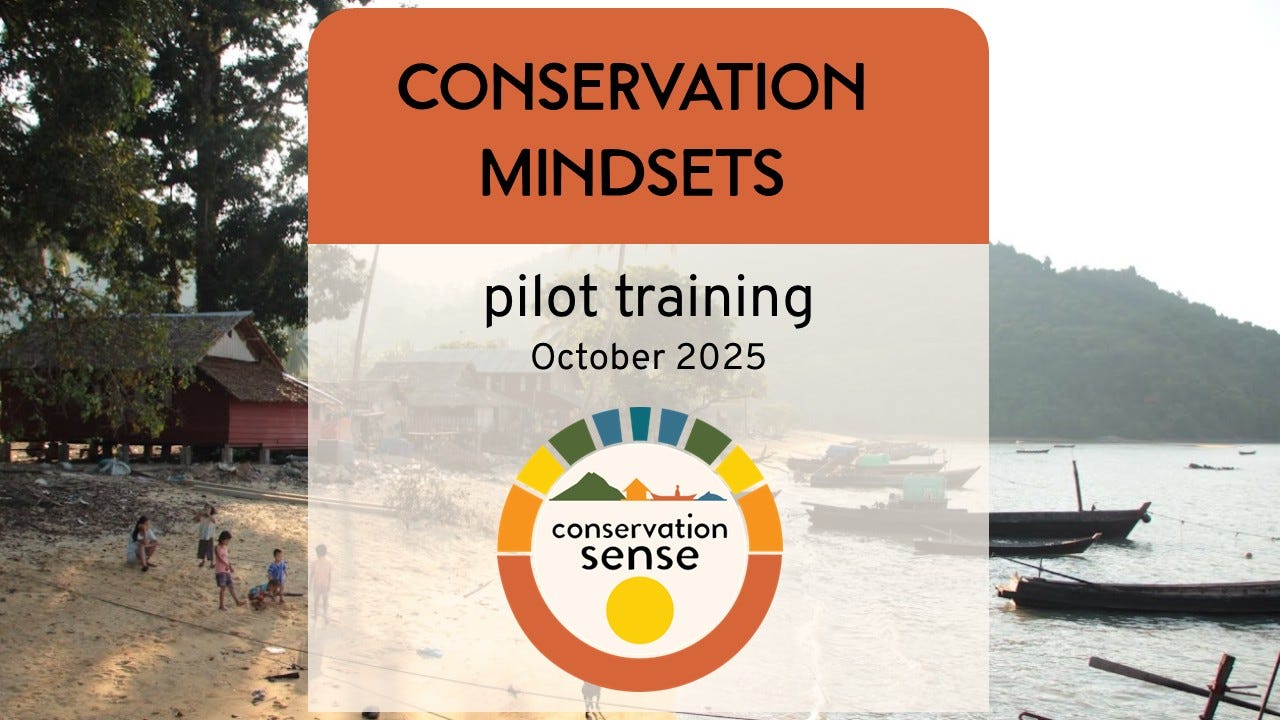
Well, it’s been a while! The bits of spare time that I tenderly scrape together for this project have been occupied in the related work of finalizing and delivering the pilot training for Conservation Mindsets, part of my Conservation Sense training series. Running that pilot was a major goal of 2025 for me; a bit of unexpected “year of the snake” action (life going completely haywire, which I’m telling myself is all working toward *growth* a la the whole “snake shedding” metaphor) earlier this year delayed it by several months, so it feels fantastic to have finally done it. And it seems to have gone well, though I’m about to send out some little “ahem, so sorry, don’t mind me, friendly reminder” posts to the participants to complete the post-training survey.
(And I also decided to go on a little surf trip, and have had a very slow re-entry to “regular life”)

So, here I am again, resuming Conservation Realist for a little bit before tucking it into a brief hibernation at the end of the year. I’m particularly excited to share the two final interviews of the year with you!
For now: some thoughts from the Conservation Mindsets pilot.
One of the things I love about conservation is the wonderful people I’ve gotten to meet, including friends who helped rustle up participants for this training and, of course, the participants themselves.
While I’m confident that what I’m offering is needed in conservation, it’s been less clear to me how to best package and present it in an accessible (relatively brief) online format, to an audience that might represent varying types of experiences in conservation. It felt surprisingly vulnerable to essentially say, “hello, I think these ideas are valuable and I think I know how to teach them; will you spend four 75-minute sessions with me and trust that it won’t be wasted?”
But this group - most of whom I’d never met (and including 2 Substack connections!) - seemed engaged and open to the experience, and generously contributed their insights to the discussions. Some of these insights particularly stimulated my thinking, and I’ll share them here:
Definitions of Conservation
To establish the “working definitions” for the course, I brought us back to basics: what is conservation, to us? Everyone presented compelling definitions, but three key ideas stood out to me:
Conservation as tactics to safeguard nature/resources
I’m intrigued by the word “tactics” here - how can we be more truly tactical, more strategic, in conservation work? I think a lot of conservation work is based on “tactics,” but without enough truly tactical thinking. Assumptions are made based on biases and oversimplified views of systems, and ethical issues are sort of crowded out by moral licensing and an inexcusable lack of situational awareness. I’ve witnessed misapplication of strategic thinking, where the strategy seems geared at “winning” against other stakeholders, which is a harmful framing of conservation in general. What I like about the word “tactics” here is the connotation of practicality, of being solutions-oriented. I’d love to see the bright minds of conservation strive for more truly grounded, practical tactics for conservation that isn’t based on manipulation or “winning,” but on building relationships for sustained positive impact.
Conservation as striving for abundance
I love this. So often, conservation feels so hardscrabble - a shortage of resources (finances, personpower, etc.) to protect against a shortage of natural resources. I personally have worked on an endangered species with *tiny*, critically endangered subpopulations, threatened by bycatch in fisheries linked to low-income communities. “Abundance” was a word that only came to mind when talking with fishers about the past. I think many of us operate in “survival mode” in various senses in our work, hoping that our work and our study systems/species can eke out a little more time on this planet. But what would it feel like, look like, to strive for abundance? This inspired me to read up a little bit on scarcity mindset vs abundance mindsets in nonprofits, and I found it quite interesting.
Here are some links:
Conservation as managing our shared resources
Of course, this idea of “shared resources” - across literal and abstract borders, across generations - is commonly cited in conservation. But in the context of this training, it struck me that when we say “shared resources,” we’re often only focusing on the sort of shared “right” or claim that multiple parties might have to a resource, for various reasons. This is often used to legitimate initiation of conservation projects by external actors - there’s a species here that “we” have deemed important to conservation, even though not all of “us” physically live in this area - because it’s a resource for us all to share.
When it comes to sharing other things, though, mainstream conservation can get a bit stingy. Sharing power? Sharing recognition? Sharing the burden that local communities often have to shoulder in carrying out externally-shaped conservation? “Sharing is caring” only when those of us in positions of relative privilege share toward equity
Obligations & social dynamics
Exploring notions of “expertise” (related to the “expertise trap” and related mindsets), one person offered up the idea that expertise comes with an obligation to share knowledge. And I like that. Those of use who have had the privilege of accessing knowledge as not just holding onto it, but morally obligated to share it. But let’s take the notion of “obligation” a little further: the obligation to share knowledge effectively and respectfully, and to use it responsibly, and to recognize - and not abuse, knowingly or unknowingly - the power that comes with knowledge. And also, an obligation to recognize the limits of that knowledge, and to continue to engage in the process of evolving our expertise by questioning our assumptions, recognizing other forms of knowledge, and remembering that expertise is not just a static status, but a process of curiosity, inquiry, and thoughtful synthesis.
“Engagement as endorsement” - While discussing the various obstacles, opportunities, and implications involved in “inclusion” and “participation,” someone acknowledged the possibility that stakeholders in their sector might feel concerned that if they participate in a conservation-related activity, even if it’s related to livelihoods, it might be construed as endorsing everything related to that activity. And that’s not necessarily something that every stakeholder wants! There are often fraught histories and relationships between conservation and communities; even if the benefits from a conservation-related training or initiative might be significant for participants, they might not want to participate if that implies “siding with” conservation. I love this realization, and I encouraged my colleagues to think about how to shift this dynamic. How can we design and implement conservation projects in a way that doesn’t make participants feel like they must choose between their values and their inclusion?
But what about the system?
Three questions popped up throughout the course:
When the conservation work we engage in is, literally, seeking to change behavior, how do we reconcile that with the “ick”/condescending, patronizing, etc. connotation that can emerge with emphasizing “behavior change” in projects?
This could be seen as “just semantics,” but there are situations where the connotations of the words we use can seep into the actions that those words describe. “Behavior change,” in particular, has a lot of baggage. Many of us would associate it with a sort of disciplinarian context, with the need to “correct” behaviors in educational settings, for example (this comes up a lot, in very problematic ways, for the nonspeaking autistic folks I work with in my other career, where misguided professionals view “problem behaviors” as willful noncompliance rather than overwhelm leading to actions that these children cannot easily control). If we go into a certain setting intent on “changing behavior,” there is a risk of subconsciously sliding into “we are the ones who dictate the change, and *they* are the ones who are problematic and must be manipulated into changing.” So, for me, I think taking a step back and framing such work more broadly as: how do we collaborate to create the conditions that support sustainable actions? Yes, behavior change is a desired outcome. But it should be part of a larger process of collaboration and shared learning, and should be a result of stakeholder agency.
It’s so difficult to accept that there are so few truly win-win situations in conservation, and that we’re always operating with trade-offs. How can we achieve a balance?
Sure, I agree that this is a tough reality. I don’t necessarily have a direct answer for this (at least, not an answer that will be succinct!), but this prompted me to respond: When we’re thinking about win-win situations and trade-offs, who gets to decide what is a “win” and how significant a “win” or a “lose” is? Who gets to negotiate what’s being traded off? Also: this feels like a sort of disconnected way of looking at things. Conservation issues are rarely a simple dichotomy - giving up one thing to the benefit of something else - but more often are a tangled web, where giving up one thing might benefit something else in the short-term, but it also might end up being counterproductive in the longer-term. So, similar to my thoughts on “behavior change”: can we take a step back and frame these situations with a wider lens? How do we facilitate a system that is more conducive to better outcomes across the board, where we better understand and navigate the complex connections in conservation issues?
While we, as individuals, might understand and embrace productive conservation mindsets and work to avoid counterproductive ones, we often hit a wall when it comes to effecting structural change to a system that entrenches counterproductive ways of working. So where does that leave us?
Ohhh this is tough. I will say that many of us have more agency and power to effect change than we realize, and that small actions or steps can indeed be meaningful (they’re not sufficient, but they can be important). Whether that means advocating for changing how your organization functions, or implementing more human-centered elements in a small activity or research project that you might be managing, or connecting with like-minded professionals to advocate to funders, societies, governments, etc., or ensuring that anyone you mentor learns about the importance of respectful co-creation with stakeholders, there are meaningful steps to be taken. I really recommend listening to this interview with Dr. Ruth Brennan, who offers a lot of experience and wisdom on this topic.
What do you think?
Do you have any thoughts on the aforementioned topics? I’d love to hear them!


